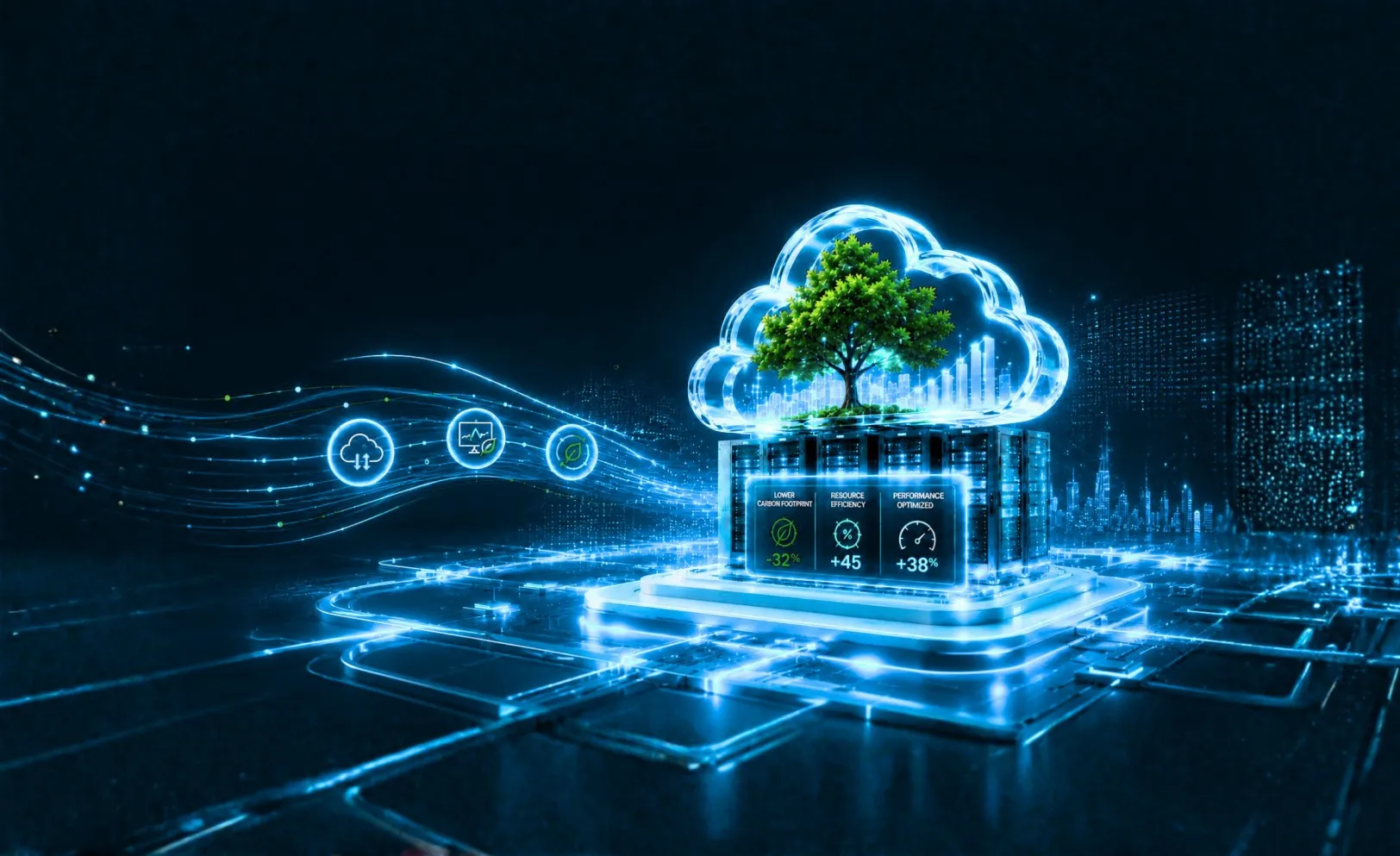
Cloud migration solved one major enterprise challenge: scalability But it also introduced a new one: cloud sustainability. Today, enterprises operate increasingly energy-intensive cloud ecosystems powered by:
Most organizations initially focused on migrating fast.
Very few prioritized:
As a result, many post-migration environments became:
The next phase of cloud transformation is no longer just about moving workloads to the cloud.
It is about building a Green Cloud strategy focused on intelligent workload distribution, sustainable AI workloads, and operational efficiency.
Because cloud environments now directly influence:
Why Cloud Sustainability Matters
Cloud environments continuously consume compute resources through:
Without cloud sustainability optimization, enterprises increase:
This is why Green Cloud strategies are becoming essential for enterprise infrastructure planning.
Organizations are increasingly investing in:
Because cloud efficiency now directly impacts both sustainability performance and operational cost.
Cloud sustainability is no longer only an ESG discussion.
It is becoming a core infrastructure optimization priority.
AI Infrastructure Efficiency Is the New Challenge
The biggest sustainability conversation in cloud today is AI infrastructure efficiency.
AI workloads require:
These workloads consume significantly more energy than traditional enterprise applications.
Many enterprises scaling generative AI systems are already experiencing:
This is accelerating demand for:
Because organizations can no longer scale AI without considering energy efficiency.
Sustainable AI workloads are becoming critical for enterprises trying to balance:
simultaneously.
Carbon-Aware Cloud Computing Changes Optimization
Traditional cloud systems optimize workloads based on:
Carbon-aware cloud computing introduces another layer:
Carbon intensity.
This means workloads can now be distributed based on:
For example, non-critical AI training workloads can shift to regions with lower carbon intensity and better energy efficiency.
This reduces:
without affecting performance.
Carbon-aware cloud computing is especially effective for:
This is becoming one of the most important innovations in sustainable cloud architecture.
Because enterprises are increasingly realizing that workload placement decisions directly impact sustainability outcomes.
Green Cloud Requires FinOps Governance
Most enterprises still approach sustainability separately from financial operations.
But Green Cloud strategies require stronger alignment between:
Modern enterprises are increasingly combining:
to improve both:
This creates measurable business value while reducing infrastructure waste.
Green Cloud is no longer only a sustainability initiative.
It is becoming an enterprise optimization framework.
Organizations that align FinOps governance with cloud sustainability gain better:
while simultaneously reducing emissions.
Multi-Cloud Complexity Is Increasing Operational Waste
Multi-cloud ecosystems provide flexibility and resilience.
But they also create operational complexity.
Many enterprises struggle with:
Without cloud ecosystem governance, organizations increase:
This is accelerating demand for:
Because cloud sustainability cannot succeed in fragmented environments.
Simplification is becoming just as important as scalability.
The Green Cloud Maturity Model
Most organizations are still early in their cloud sustainability journey.
Green Cloud transformation typically evolves across five stages:
Level 1: Migration
Focus on cloud adoption and scalability.
Level 2: Visibility
Measure utilization, cloud costs, and infrastructure consumption.
Level 3: Optimization
Implement workload rightsizing, cloud cost optimization, and infrastructure efficiency.
Level 4: Carbon Awareness
Adopt carbon-aware cloud computing and operational carbon visibility.
Level 5: Autonomous Sustainability
Deploy sustainability-driven automation, adaptive compute balancing, and autonomous infrastructure optimization.
This maturity model helps enterprises scale cloud environments more sustainably over time while improving both efficiency and governance.
Sustainable Cloud Architecture Requires Automation
Manual optimization is no longer enough.
Modern cloud ecosystems change dynamically every second.
Sustainable cloud architecture now requires:
Automation allows organizations to continuously optimize:
Without automation, Green Cloud strategies become difficult to sustain at enterprise scale.
This is why intelligent cloud operations are becoming central to enterprise cloud modernization strategies.
The Future of Cloud Will Be Efficiency-Driven
The next generation of cloud leaders will not be organizations operating the largest infrastructure ecosystems.
They will be organizations building:
Cloud transformation alone is no longer enough.
The future belongs to enterprises that optimize cloud ecosystems intelligently, sustainably, and economically.
Cloud computing is entering a new operational era.
An era where:
are becoming inseparable.
Green Cloud strategies help enterprises reduce operational waste, improve workload efficiency, and build sustainable cloud architecture for long-term scalability because the future of cloud infrastructure will not be defined only by how fast organizations scale. It will be defined by how sustainably that scale is achieved.