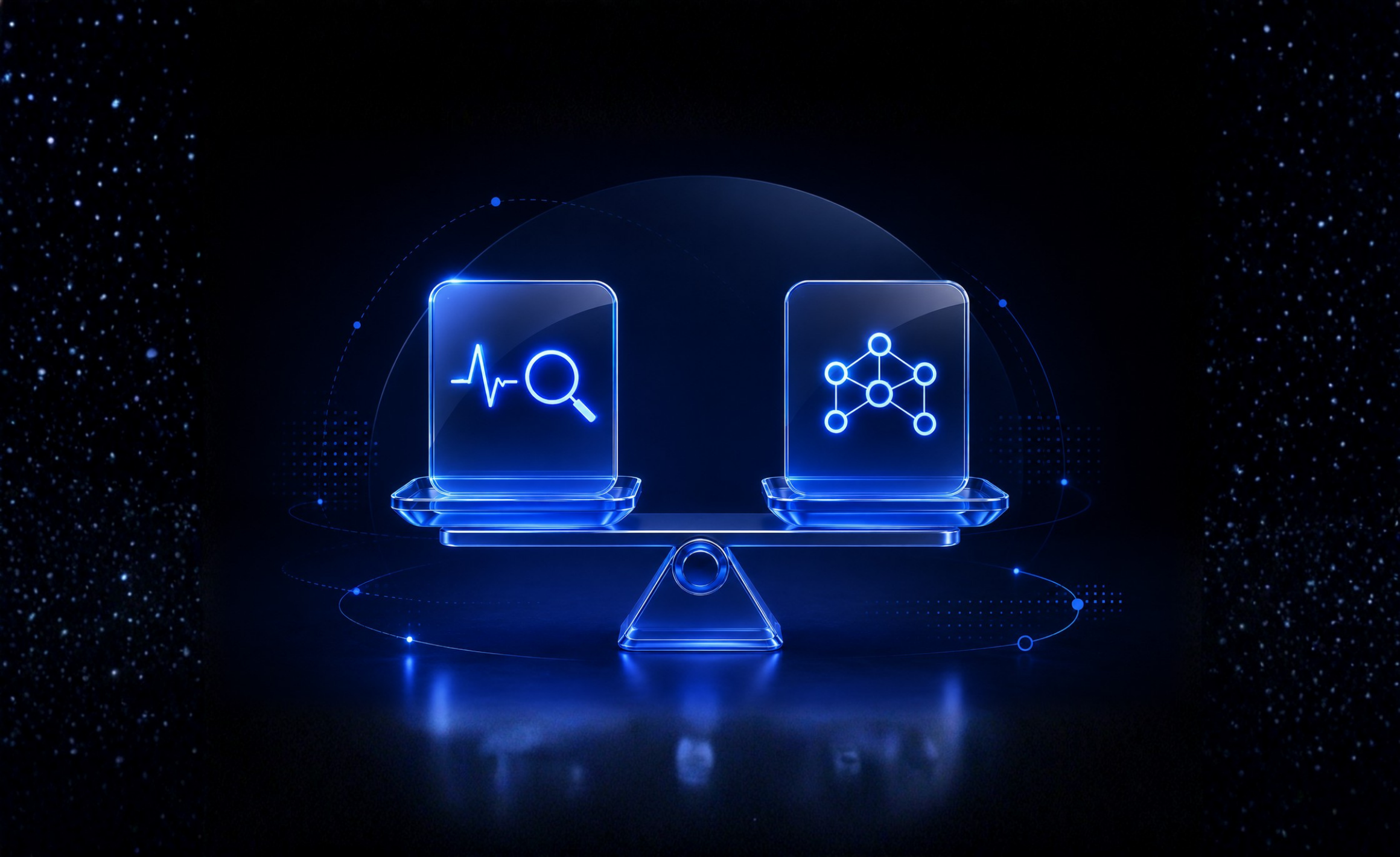
Monitoring tells you when something is wrong. Observability helps you understand why.
That distinction sounds simple, but it becomes increasingly important as enterprise IT environments become more distributed.
Applications now run across cloud platforms, data centres, containers, APIs, networks and third-party services. A single customer transaction can depend on dozens of interconnected components.
In this environment, simply knowing that something failed is no longer enough.
IT teams need to understand what happened, where it happened and what caused it.
What Monitoring Actually Does
Monitoring focuses on known conditions.
It answers questions such as: Is the server running? Is CPU utilisation too high? Is the application available? Is network latency above the threshold? Is storage capacity running low?
Monitoring is extremely useful.
It provides visibility into predefined metrics and helps teams detect known problems quickly. But monitoring has a limitation.
You generally need to know what you're looking for before you can monitor it effectively.
What Observability Adds
Observability focuses on understanding system behaviour from the data systems generate.
Instead of asking only whether a component is healthy, teams can investigate relationships between metrics, logs, traces, events, application behaviour and infrastructure performance.
This becomes particularly valuable when the problem isn't obvious.
An application may report slow performance even though its server looks healthy.
The actual cause could be a database dependency, API latency, network issue or another downstream service.
Observability helps teams investigate that chain.
Monitoring Detects. Observability Investigates.
A useful way to think about the difference is:
Monitoring answers: “Is something wrong?” Observability helps answer: “Why is it wrong?”
You don't necessarily need to choose one over the other.
In mature IT environments, monitoring and observability work together.
Monitoring provides continuous detection.
Observability provides deeper investigation and context.
Where AIOps Fits
AIOps can help connect the two.
Modern environments generate too many events for teams to manually analyse every signal.
AIOps can help correlate events, identify patterns, reduce duplicate alerts and prioritise incidents based on context.
Instead of presenting ten separate alerts, an intelligent operations platform may identify that those alerts are symptoms of a single underlying incident.
That reduces noise and helps IT teams focus on what actually matters.
What Does Your IT Team Need?
The answer depends on the environment.
If the primary requirement is ensuring that infrastructure stays within defined performance and availability thresholds, monitoring may be sufficient.
If applications are distributed across multiple dependencies and teams regularly struggle to identify root cause, observability becomes much more valuable.
If the environment generates large volumes of operational data and alerts, AIOps can help connect those signals and automate parts of the investigation.
For many enterprises, the answer isn't monitoring versus observability. It is:
Monitoring + Observability + Intelligent Operations
The NOC Is Becoming More Context-Aware
Traditional NOC teams often focus on alert detection and escalation.
Modern NOCs increasingly need to understand service relationships and business impact. A database alert isn't necessarily important because the database itself is unhealthy.
It matters if the database problem is affecting a business-critical application.
That shift requires IT operations to move from component-level monitoring toward service-level visibility.
Don't Buy Observability Just Because It Is the New Buzzword
Observability is not automatically better.
It can generate significant amounts of telemetry, storage requirements and operational complexity. If teams don't know which signals matter, adding more data can create another form of noise.
The question should therefore not be: “Do we need observability?”
It should be:
“What operational questions are we currently unable to answer?”
If your team can't identify root cause quickly, understand application dependencies or trace issues across distributed environments, observability may solve a real problem.
If the challenge is simply detecting infrastructure failures, traditional monitoring may still be the right tool.
The Practical Answer
Monitoring and observability solve different problems.
Monitoring helps you know when systems deviate from expected conditions. Observability helps you investigate unexpected behaviour.
AIOps can help correlate those signals and turn operational data into actionable insight. The goal isn't to deploy the most advanced monitoring stack.
The goal is to reduce uncertainty when something goes wrong.
Because when an incident occurs, your IT team doesn't need another dashboard asking: “Did something happen?”
They need an answer to the more important question:
“What happened, why did it happen, and what should we do next?”