Most IT Strategies Don't Failin the Boardroom. They Fail on Monday Morning.
The executive team approves a digitaltransformation roadmap .
Budgets are allocated.
Cloud migration begins.
New cybersecurity platforms are deployed.
Automation initiatives are announced.
Six months later, the vision remainsunchanged—but execution has slowed.
Projects compete for resources.
Teams work in silos.
Infrastructure evolves faster thangovernance.
Different vendors manage differenttechnologies with different priorities.
The strategy is still sound.
The organization simply cannot execute itconsistently.
This is where many enterprises losemomentum.
Research from industry analystsconsistently shows that the majority of digital transformation initiativesfail to fully achieve their intended business outcomes ,not because organizations lack vision, but because execution struggles to keeppace with ambition.
The competitive advantage no longer belongsto organizations with the boldest strategy.
It belongs to those with the strongestoperational foundation.
Strategy Creates Possibility.Operations Create Results.
Every enterprise strategy begins withaspiration.
Modernize infrastructure.
Adopt AI.
Strengthen cybersecurity.
Improve customer experiences.
Accelerate innovation.
Yet every strategic objective eventuallybecomes an operational challenge.
Can infrastructure support new workloads?
Can applications integrate seamlessly?
Can security policies evolve withoutslowing innovation?
Can teams collaborate across multiplevendors?
Execution is not one decision.
It is thousands of operational decisionsmade every day.
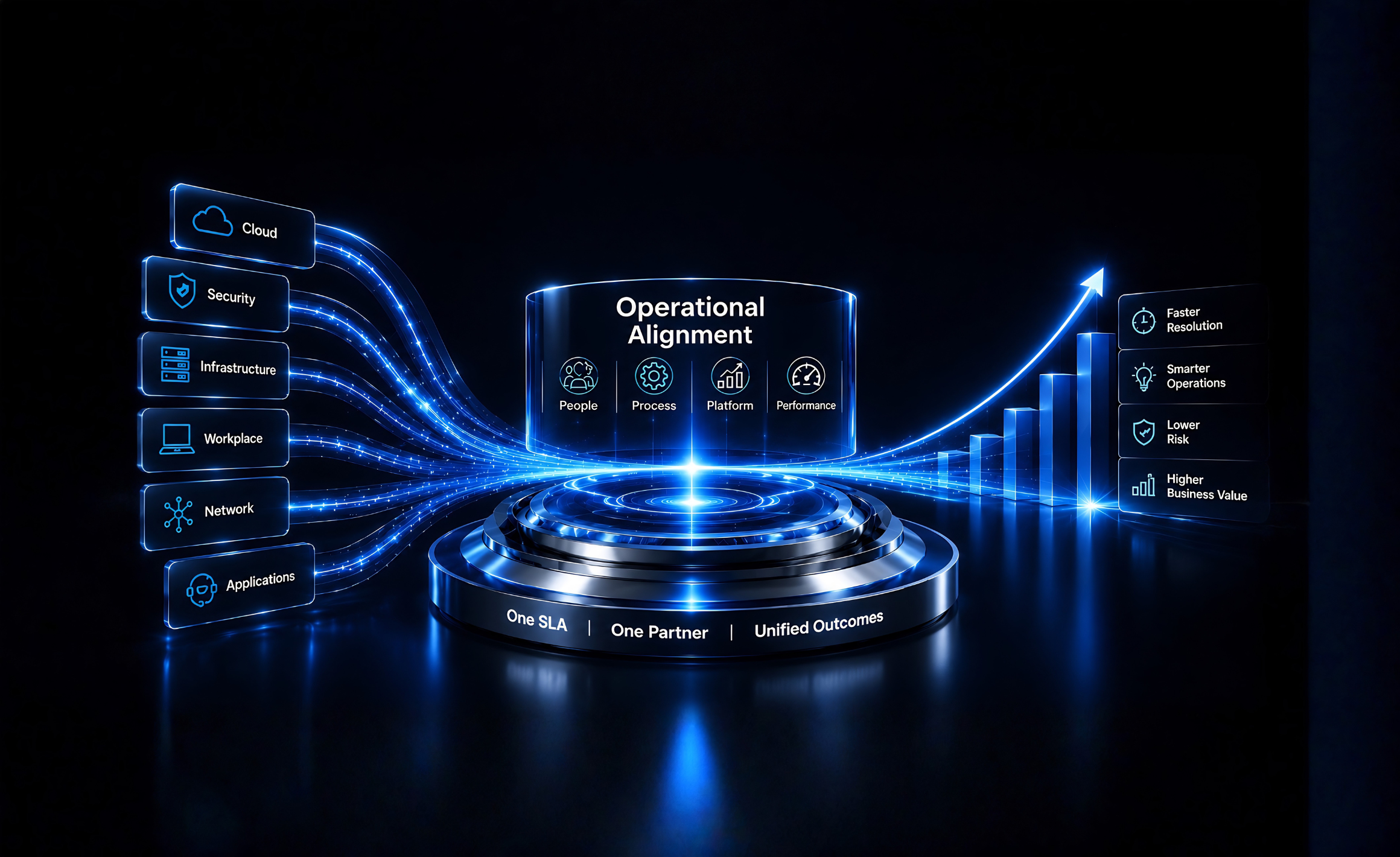
Organizations that consistently outperformtheir competitors recognize that operational alignment is what transforms strategic intent into measurable business outcomes.
The Hidden Friction That SlowsTransformation
Execution rarely fails because of one majorissue.
It slows because of dozens of smalloperational barriers.
Consider these familiar enterprisescenarios:
Scenario 1: Cloud Without Coordination
A company successfully migrates workloadsto the cloud.
However, networking, security, andinfrastructure teams continue working independently.
Simple changes require multiple approvals.
Innovation slows—not because of technology,but because operations remain fragmented.
Scenario 2: AI Without Operational Readiness
An organization invests in AI-poweredanalytics.
The platform delivers valuable insights.
But inconsistent data governance anddisconnected business processes prevent teams from acting on those insights.
Technology advances.
Business outcomes do not.
Scenario 3: Multiple Vendors, Multiple Priorities
A critical application outage requirescoordination across cloud providers, infrastructure partners, and securityvendors.
Each team performs well individually.
No one owns the end-to-end outcome.
Recovery is delayed because accountabilityis fragmented.
Operational Alignment CreatesEnterprise Freedom
Freedom in enterprise technology is oftenmisunderstood.
It is not the freedom to operate withoutgovernance.
It is the freedom to innovate withoutoperational friction.
Organizations with strong operationalalignment ensure that infrastructure, cloud, security, workplace services,and business applications move toward shared business objectives.
When alignment improves:
Execution becomes an organizationalcapability rather than a project milestone.
Governance AcceleratesExecution
Governance is frequently associated withcompliance.
Leading organizations use it differently.
They use governance to remove ambiguity.
Strong IT governance provides:
Governance does not slow execution.
Poor governance does.
The Execution FoundationFramework
Organizations that consistently translatestrategy into measurable business outcomes strengthen six interconnectedoperational capabilities rather than focusing on technology alone.
1. Strategic Alignment
Every technology initiative must support ameasurable business objective.
Without alignment, technology investmentsbecome isolated projects.
Leaders need real-time visibility intoinfrastructure, applications, workloads, and service performance.
Organizations cannot improve what theycannot measure.
3. Governance by Design
Governance should be embedded intooperational processes—not added afterward.
Clear policies, ownership, and standardscreate consistency at scale.
4. IntelligentAutomation
Automation should eliminate repetitiveoperational activities while improving speed, accuracy, and consistency.
Teams spend less time managing technologyand more time enabling innovation.
5. UnifiedAccountability
One incident.
One ownership model.
One measurable outcome.
Clear accountability acceleratesdecision-making and reduces operational delays.
6. Continuous Optimization
Execution is not static.
High-performing organizations continuouslyevaluate performance, simplify operations, optimize workloads, and refinegovernance as business priorities evolve.
Together, these six capabilities transformstrategy into sustainable execution.
Why Unified IT OwnershipChanges Everything
Modern enterprises rarely fail becauseteams lack expertise.
They fail because expertise is fragmented.
Infrastructure.
Cloud.
Security.
Endpoints.
Networks.
Applications.
Each technology domain often has adifferent owner.
During transformation, this fragmentationcreates delays.
Organizations operating with a One SLA,One Partner model simplify execution through:
Instead of coordinating multiple providers,leaders coordinate business outcomes.
Execution becomes simpler becauseresponsibility becomes clearer.
Operational Excellence Is aCompetitive Advantage
This is because operational excellencecreates strategic flexibility.
Organizations can:
Execution becomes the organization'scompetitive advantage.
Freedom is no longer defined by ambitiousstrategy.
It is defined by consistent delivery.
At Orient Technologies, we've observed that organizations rarely strugglebecause they lack technology. More often, execution slows when infrastructure,cloud, security, and workplace operations evolve independently instead ofthrough a unified operating model. Strengthening these operational foundationsis what enables technology investments to deliver measurable business valueover time.
Final Thought
Strategy gives organizations direction.
Execution gives them momentum.
Technology creates possibilities.
Operations create outcomes.
The enterprises that will lead tomorrow arenot the ones that invest in the most technology.
They are the ones that build operationalfoundations strong enough to turn every strategic decision into measurablebusiness value.
Because in enterprise IT, freedom is notthe ability to imagine what is possible.
Freedom is the ability to execute whatmatters—consistently, confidently, and at scale.